Bangkok Expat Survival Phrases: Taxis, Food & Everyday Thai
The Bangkok Thai phrases expats actually use — taxis, ordering food, shopping and emergencies. Practical, real-life lines with free audio.
Bangkok Survival Phrases — Study Deck
ขอเผ็ดน้อยๆนะครับ
Free to start · 2starter decks · no card needed
These cards are free to study right here. The full deck library and spaced repetition live in the app.
Bangkok Expat Survival Phrases: Essential Thai for Daily Life
Moving to or visiting Bangkok can be exhilarating—the vibrant street markets, incredible food, and bustling energy are unforgettable. But daily life in Thailand's capital requires navigating language barriers that go beyond tourist phrases. As an expat, you need practical Thai for taxis, markets, restaurants, and unexpected situations.
This comprehensive guide covers essential Bangkok expat survival phrases with a focus on real-world usage, cultural context, and audio practice. Whether you're here for a month or a year, these phrases will transform your daily experience.
Stuck on something? Email me. I'm Richard. I'm learning Thai from a book, and I built this app for it.
Why Learning Bangkok-Specific Thai Matters
Beyond Tourist Phrases
Tourist Thai gets you through the hotel and temple visits. Expat Thai gets you through:
- Taxi negotiations during rush hour
- Food customization at street stalls
- Market bargaining for fair prices
- Emergency situations when you need help
- Building relationships with local neighbors
Cultural Integration Benefits
Learning practical Thai shows respect and earns you:
- Better prices: Vendors appreciate the effort
- Deeper connections: Locals open up when you try
- Safer experiences: Clear communication in emergencies
- Daily convenience: Simple tasks become effortless
 Bangkok taxi scene with essential Thai phrases
Category 1: Transportation & Navigation
Bangkok's transportation network is world-class but requires specific language skills.
Taxis & Rideshare Essentials
1. "Pai [destination] dai mai?" (ไป...ได้ไหม) Pronunciation: bpai [destination] dâi mǎi Meaning: "Can we go to...?" Usage: Essential for all taxi rides. Fill in your destination. Example: "Pai Siam Paragon dai mai?" (Can we go to Siam Paragon?) Audio tip: Record this phrase clearly—it's your most used taxi phrase.
2. "Lot nôoi" (ล็อดหน่อย) Pronunciation: lót nôy Meaning: "Stop here please" Usage: When you see your destination or need to stop suddenly Cultural note: Add "krap" (male) or "ka" (female) for politeness
3. "Chai meter dai mai?" (ใช้มิเตอร์ได้ไหม) Pronunciation: chái mí-dtêr dâi mǎi Meaning: "Can you use the meter?" Usage: Politely request meter use instead of negotiated price Alternative: "Chai meter dai mai?" (ใช้มิเตอร์ได้ไหม) - more formal
4. "Mai klai, dtrong bpai" (ไม่ไกล ตรงไป) Pronunciation: mâi glai, dtrong bpai Meaning: "Not far, go straight" Usage: When taxi asks if you know the way
BTS/MRT Navigation
5. "Pai BTS [station] dai yang rai?" (ไป BTS...ได้ยังไง) Pronunciation: bpai BTS [station] dâi yang ngai Meaning: "How do I get to BTS [station]?" Usage: Asking for directions to Skytrain stations Pro tip: Learn 5 nearest BTS stations to your home/work
6. "Exit tee nai?" (ออกทางไหน) Pronunciation: òk taang nǎi Meaning: "Which exit?" Usage: At BTS/MRT stations with multiple exits Bangkok specific: Exits can be 500m apart—crucial to ask!
7. "Rap BTS dai mai?" (รับ BTS ได้ไหม) Pronunciation: ráp BTS dâi mǎi Meaning: "Do you accept BTS card?" Usage: At shops near BTS stations (many do) Note: Rabbit card is Bangkok's transit payment card
Category 2: Food & Dining
Bangkok's food scene is legendary, but ordering requires specific language.
Street Food Mastery
8. "Ao [dish] nung jaan" (เอา...หนึ่งจาน) Pronunciation: ao [dish] nèung jaan Meaning: "One order of [dish] please" Usage: Basic ordering at any food stall Example: "Ao pad thai nung jaan" (One pad thai please) Audio practice: Record yourself saying your 5 favorite dishes
9. "Mai sai [ingredient]" (ไม่ใส่...) Pronunciation: mâi sài [ingredient] Meaning: "Don't add [ingredient]" Usage: Customizing orders for allergies/preferences Common uses:
- "Mai sai namtan" (No sugar)
- "Mai sai phet" (Not spicy)
- "Mai sai hoy" (No shellfish)
10. "Phet mai?" (เผ็ดไหม) Pronunciation: pèt mǎi Meaning: "Is it spicy?" Usage: Essential for managing spice levels Follow-up: "Phet nit noy" (A little spicy) or "Mai phet" (Not spicy)
11. "Gep taang" (เก็บถุง) Pronunciation: gèp tăng Meaning: "Takeaway" (literally "keep in bag") Usage: When you want food to go Alternative: "Ao bpen taang" (เอาเป็นถุง)
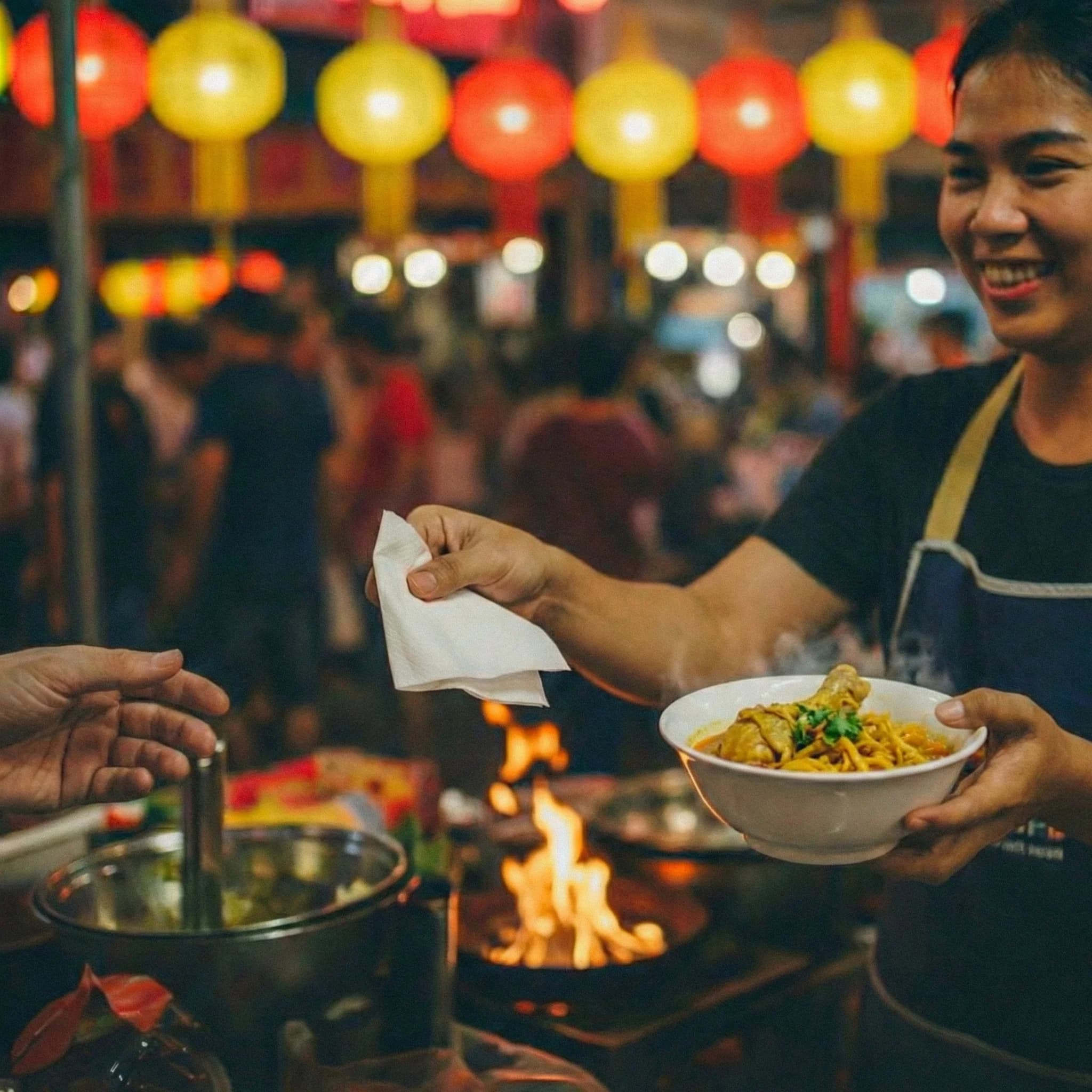 Bangkok street food ordering scene with phrases
Restaurant & Cafe Phrases
12. "Check bin" (เช็คบิล) Pronunciation: chék bin Meaning: "Bill please" Usage: Asking for the check More polite: "Check bin noi" (Bill please, a bit)
13. "Nam plao" (น้ำเปล่า) Pronunciation: nám plao Meaning: "Plain water" Usage: Free water at restaurants Note: Often served with ice ("nam kaeng")
14. "Mai ao..." (ไม่เอา...) Pronunciation: mâi ao... Meaning: "I don't want..." Usage: Refusing upsells or extras Example: "Mai ao dessert" (No dessert)
15. "Aroy maak" (อร่อยมาก) Pronunciation: à-ròi mâak Meaning: "Very delicious" Usage: Compliment the chef/staff Cultural note: Thais appreciate food compliments
Category 3: Shopping & Services
Bangkok is a shopper's paradise if you know the right phrases.
Market Bargaining
16. "Tao rai?" (เท่าไหร่) Pronunciation: tâo rǎi Meaning: "How much?" Usage: Basic price inquiry Pronunciation tip: The "r" is soft, almost like "l"
17. "Lot raka dai mai?" (ลดราคาได้ไหม) Pronunciation: lót raa-kaa dâi mǎi Meaning: "Can you give a discount?" Usage: Polite bargaining opener Alternative: "Lot noi dai mai?" (ลดหน่อยได้ไหม)
18. "Paeng" (แพง) Pronunciation: paeng Meaning: "Expensive" Usage: Negotiation tactic Follow-up: "Lot noi dai mai?" (Can you reduce a bit?)
19. "Mai ao, khop khun" (ไม่เอา ขอบคุณ) Pronunciation: mâi ao, kàwp kun Meaning: "No thanks, I don't want it" Usage: Polite refusal when price is too high Important: Always smile when saying this
Services & Daily Needs
20. "Chai internet dai mai?" (ใช้อินเทอร์เน็ตได้ไหม) Pronunciation: chái in-dtêr-nét dâi mǎi Meaning: "Do you have WiFi?" Usage: Cafes, restaurants, co-working spaces Follow-up: "Password arai?" (Password?)
21. "Tong gaan [service]" (ต้องการ...) Pronunciation: dtâwng gaan [service] Meaning: "I need [service]" Usage: Various service requests Examples:
- "Tong gaan sam rap" (I need laundry service)
- "Tong gaan chat fon" (I need air conditioning repair)
- "Tong gaan liang maa" (I need a vet)
22. "Jaai ngern sot dai mai?" (จ่ายเงินสดได้ไหม) Pronunciation: jàai ngern sòt dâi mǎi Meaning: "Can I pay in cash?" Usage: When card payment isn't available Note: Many places prefer cash, especially markets
Category 4: Social & Emergency
Building Relationships
23. "Sawasdee krap/ka" (สวัสดีครับ/ค่ะ) Pronunciation: sà-wàt-dii kráp/kâ Meaning: "Hello" (with politeness particle) Usage: Standard greeting, use all day Gender note: Men say "krap," women say "ka"
24. "Khop khun krap/ka" (ขอบคุณครับ/ค่ะ) Pronunciation: kàwp kun kráp/kâ Meaning: "Thank you" Usage: Use constantly—Thais appreciate gratitude Enhanced: "Khop khun maak krap/ka" (Thank you very much)
25. "Mai pen rai" (ไม่เป็นไร) Pronunciation: mâi bpen rai Meaning: "No problem"/"You're welcome" Usage: Response to thank you or apology Cultural note: Reflects Thai easy-going attitude
26. "Kor toht krap/ka" (ขอโทษครับ/ค่ะ) Pronunciation: kǎw tôht kráp/kâ Meaning: "Sorry"/"Excuse me" Usage: Apologizing or getting attention Situation: Use when bumping someone or interrupting
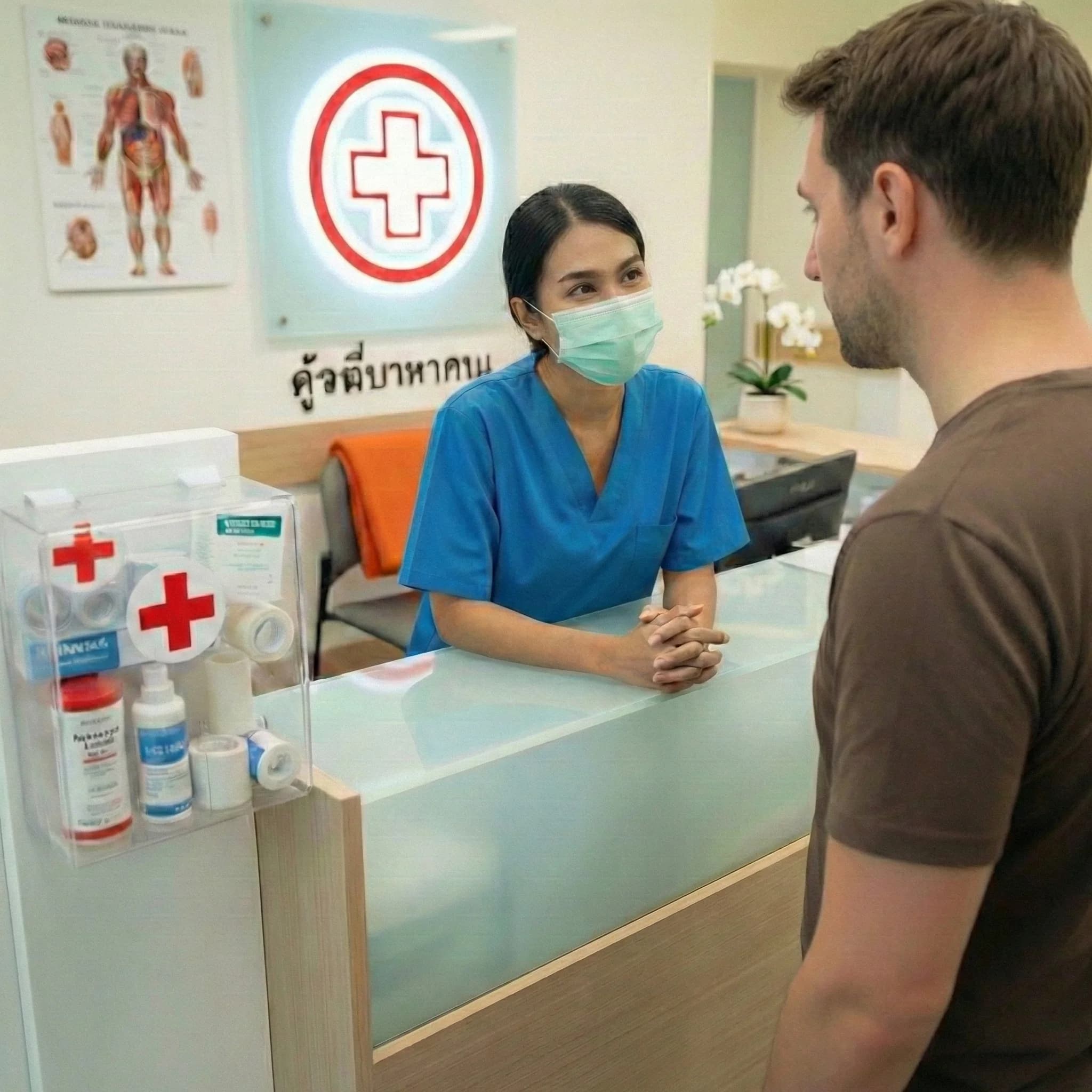 Bangkok emergency services scene with essential phrases
Emergency Situations
27. "Chooay duay!" (ช่วยด้วย) Pronunciation: chûay dûay Meaning: "Help!" Usage: Emergency situations Important: Loud and clear pronunciation
28. "Pai roong phayaban" (ไปโรงพยาบาล) Pronunciation: bpai roong pá-yaa-baan Meaning: "Take me to hospital" Usage: Medical emergencies Add: "[Hospital name] dai mai?" for specific hospital
29. "Tam ruat" (ตำรวจ) Pronunciation: dtam rùat Meaning: "Police" Usage: Need police assistance Full phrase: "Tam ruat maa duay" (Call police please)
30. "Mee [problem]" (มี...) Pronunciation: mee [problem] Meaning: "There is [problem]" Usage: Describing issues Examples:
- "Mee kha-moi" (มีขโมย) (There's a thief)
- "Nam rua" (น้ำรั่ว) (There's a leak)
- "Mee kon jep" (Someone is hurt)
Don't just survive—thrive.
Master these 30 phrases and 500+ more with our smart flashcard system. Two starter decks, no card to sign up.
Start learning Thai free →Free to start · 2 starter decks · no card needed
Audio Practice Strategies
Using Effortless Thai for Real-World Practice
-
Record Real Conversations
- Ask permission first: "Kor tai dai mai?" (Can I record?)
- Capture taxi drivers, market vendors, restaurant staff
- Review and create flashcards from authentic audio
-
Phrase Repetition Drills
- Record yourself saying each phrase
- Compare to native speaker audio
- Focus on tone accuracy (use Paiboon visual guides)
-
Situation Simulation
- Create audio scenarios: "You're in a taxi to Siam Paragon"
- Practice full conversations, not just isolated phrases
- Include natural filler words: "Err...", "Let me think..."
-
Progress Tracking
- Record yourself monthly saying key phrases
- Notice improvement in fluency and confidence
- Identify persistent pronunciation issues
Recommended Practice Routine
Daily (10 minutes):
- Review 5 transportation phrases with audio
- Practice 3 food ordering scenarios
- Record 1 new phrase attempt
Weekly (30 minutes):
- Visit a market and actually use 3 phrases
- Record real interactions (with permission)
- Review audio and note improvements
Monthly:
- Test all 30 phrases in real situations
- Record progress comparison
- Add 5 new situation-specific phrases
Cultural Context & Etiquette
Tone Matters
- Use polite particles: Always end sentences with "krap" (male) or "ka" (female)
- Soft tone: Thais prefer gentle, polite speech
- Smile: It's part of communication, not just reaction
Hierarchy Awareness
- Respect elders: Use more formal language
- Service staff: Still use polite forms
- Friends: Can relax formality over time
Non-Verbal Communication
- Wai greeting: Learn appropriate situations
- Head position: Don't point feet at people
- Personal space: Generally closer than Western norms
Common Mistakes to Avoid
- Speaking too fast: Thais appreciate clear, measured speech
- Skipping politeness particles: Makes you sound rude
- Assuming English will work: Many Thais appreciate Thai attempts
- Getting frustrated: Language learning is a journey, not destination
- Not practicing tones: Invest in tone mastery early
Next Steps in Your Thai Journey
Phase 1: Survival (First Month)
- Master these 30 phrases
- Practice daily in safe environments
- Build confidence with basic interactions
Phase 2: Communication (Months 2-3)
- Expand to 100+ phrases
- Start simple conversations
- Understand common responses
Phase 3: Fluency Building (Months 4-6)
- Learn sentence structures
- Handle complex situations
- Build vocabulary systematically
Phase 4: Integration (6+ Months)
- Think in Thai phrases
- Understand cultural nuances
- Build genuine relationships
Tools & Resources
Effortless Thai Features for Bangkok Expats:
- Audio Capture: Record real Bangkok conversations
- Phrase Library: Pre-loaded with these 30+ phrases
- Tone Visualization: Paiboon guides for accurate pronunciation
- Spaced Repetition: FSRS algorithm for efficient memorization
- Progress Tracking: Monitor your Bangkok Thai improvement
Additional Resources:
- Bangkok Expat Groups: Practice with fellow learners
- Language Exchange: Meet Thai speakers wanting to learn your language
- Local Classes: Many affordable options in Bangkok
- YouTube Channels: Bangkok-specific Thai lessons
Conclusion: Your Bangkok Language Journey
Learning Bangkok survival Thai transforms your experience from "tourist" to "local." These 30 phrases are your foundation—the building blocks for deeper language learning and cultural integration.
Remember:
- Start small: Master 5 phrases perfectly before adding more
- Practice authentically: Use phrases in real situations
- Embrace mistakes: Every error is a learning opportunity
- Celebrate progress: Notice each small communication victory
Bangkok rewards those who make the effort to connect in Thai. With these phrases and consistent practice, you'll navigate daily life with confidence and build meaningful connections in your new home.
Further reading:
- Why Paiboon vs RTGS for Learning Thai Tones
- How FSRS Boosts Thai Vocabulary Retention
- Common Thai Pronunciation Mistakes & How to Fix Them
Bangkok resources:
- Bangkok Expats Facebook Group
- AUA Language Center (Bangkok)
- Learn Thai with Mod (YouTube)
- Thai Language Hut School
Related Articles
Thai Immigration Office Phrases: 90-Day Report & Visa
At Thai immigration, say ขอต่อวีซ่า (khɔ̌ɔ dtɔ̀ɔ wii-sâa) to extend a visa and มารายงานตัว (maa raai-ngaan dtua) for the 90-day report. Tones + audio.
Thai Phrases for Renting a Motorbike (with Audio)
To rent a motorbike, say อยากเช่ามอเตอร์ไซค์ (yàak châo mɔɔ-dtəə-sai). The Thai for the shop, the petrol pump and a breakdown, with tones and audio.