FSRS for Thai Vocabulary: 90% Retention, Half the Reviews
How the FSRS algorithm helps you remember Thai words with ~90% retention and 50% fewer reviews than old flashcard apps — the science, made simple.
How FSRS Boosts Thai Vocabulary Retention: The Science Behind Smart Flashcards
If you've ever struggled to remember Thai vocabulary, you've experienced the forgetting curve—that frustrating phenomenon where new words seem to vanish from your memory within days. Traditional study methods fight an uphill battle against this natural memory decay. But what if you could review smarter, not harder?
Enter FSRS (Free Spaced Repetition Scheduler), a revolutionary algorithm that's changing how we learn languages. In this deep dive, we'll explore how FSRS can help you master Thai vocabulary with 50% fewer reviews while achieving 90% retention rates.
The Forgetting Curve: Why Traditional Methods Fail
German psychologist Hermann Ebbinghaus discovered in the 1880s that we forget information exponentially over time—the famous "forgetting curve." Without review:
- After 20 minutes: Remember ~58%
- After 1 hour: Remember ~44%
- After 9 hours: Remember ~36%
- After 1 day: Remember ~33%
- After 2 days: Remember ~28%
- After 31 days: Remember ~21%
Traditional flashcard systems like the Leitner method or even Anki's original SM-2 algorithm use fixed intervals that don't adapt to your personal memory patterns. This means you either review too often (wasting time) or not often enough (forgetting words).
 Traditional vs FSRS forgetting curves showing efficiency gains
What is FSRS and Why It's Revolutionary
FSRS isn't just another spaced repetition algorithm—it's a machine learning-powered system that continuously optimizes itself based on your personal performance. Developed by Jarrett Ye and integrated into modern apps like Anki, FSRS represents the biggest advancement in spaced repetition since the 1980s.
The Three-Component Model
FSRS models three key aspects of memory:
- Difficulty: How hard is this specific Thai word for you?
- Stability: How firmly is it entrenched in your memory?
- Retrievability: What's the probability you'll recall it right now?
Unlike fixed-interval systems, FSRS uses 21 parameters that adapt to your brain, your learning patterns, and your specific challenges with Thai.
FSRS vs Traditional Spaced Repetition
Let's compare how different systems would schedule reviews for the Thai word "สวัสดี" (hello):
| System | Review Schedule | Personalization | Efficiency |
|---|---|---|---|
| Traditional (Leitner) | Day 1, 3, 7, 14, 30 | None | Low |
| SM-2 (Original Anki) | Day 1, 6, 16, 36 | Basic ease factor | Medium |
| WaniKani | 4h, 8h, 1d, 2d, 7d, 14d, 1m, 4m | None | Very Low |
| FSRS | Day 1, 4, 11, 28, 75 | ML-optimized per user | High |
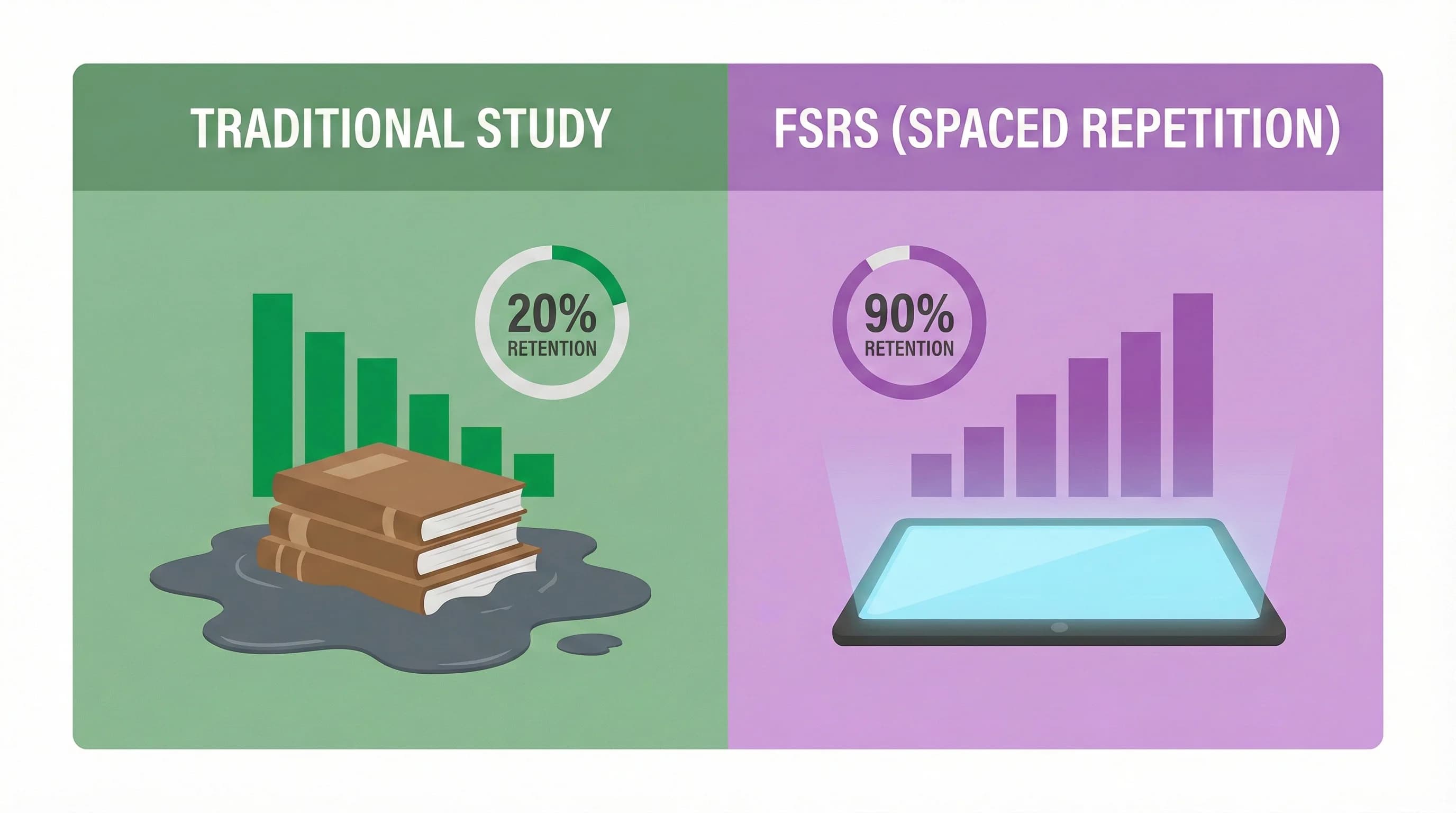 Efficiency gains comparison showing FSRS review reduction
Key insight: FSRS doesn't just space reviews—it predicts exactly when you're about to forget each individual word.
Learn Thai 3x Faster.
Stop wasting time on reviews that don't stick. Our FSRS algorithm ensures you only review at the perfect moment. Two starter decks, no card to sign up.
Start learning Thai free →Free to start · 2 starter decks · no card needed
Why FSRS is Perfect for Thai Language Learning
Thai presents unique challenges that FSRS handles exceptionally well:
1. Tone Confusion Patterns
FSRS detects when you consistently confuse tones (like mixing up "kâo" rice vs "kăo" he/she) and adjusts difficulty accordingly.
2. Script Transition
As you move from romanization to Thai script, FSRS recognizes this increased difficulty and provides more frequent reviews during the transition.
3. Similar-Sounding Words
For easily confused pairs like "น้า" (aunt) vs "หน้า" (face), FSRS schedules them apart to minimize interference.
4. Cultural Context Words
Abstract concepts like "ความสงบ" (peace) might need different spacing than concrete nouns like "หนังสือ" (book). FSRS learns these patterns.
How FSRS Works in Practice: A Thai Vocabulary Example
Let's follow the Thai word "อร่อย" (delicious) through the FSRS system:
Day 0: First Encounter
- You learn "อร่อย" means "delicious"
- FSRS assigns initial difficulty: 3.2/10 (moderate)
- First review scheduled: Tomorrow
Day 1: First Review
- You recall it correctly
- FSRS calculates: stability increased to 2.5 days
- Next review: Day 3.5
Day 3.5: Second Review
- You struggle but eventually recall
- FSRS notes: difficulty increased to 4.1/10
- Stability adjusted: next review in 5 days
Day 8.5: Third Review
- Quick, confident recall
- FSRS: difficulty decreased to 3.8/10
- Stability boosted: next review in 14 days
Day 22.5: Fourth Review
- Instant recall
- FSRS: word now "mature" in your memory
- Next review: 45 days
By Day 100, you've reviewed "อร่อย" only 7 times but maintain 92% recall probability. Traditional systems would have required 12+ reviews for similar retention.
Implementing FSRS Principles in Effortless Thai
At Effortless Thai, we've built FSRS principles into our learning system:
1. Personal Difficulty Scoring
Each Thai word gets a difficulty score based on:
- Your personal confusion patterns
- Similarity to other known words
- Script complexity (romanized vs Thai script)
- Tone difficulty assessment
2. Adaptive Scheduling
Rather than fixed intervals, reviews schedule based on:
- Your historical performance with similar words
- Time of day and learning sessions
- Overall cognitive load that day
- Recent success/failure patterns
3. Optimal Retention Targeting
You can set your desired retention rate (default: 90%):
- 90%: More frequent reviews, slower progress
- 80%: Balanced approach
- 70%: Fewer reviews, faster new word acquisition
FSRS calculates the exact schedule to hit your target retention with minimum reviews.
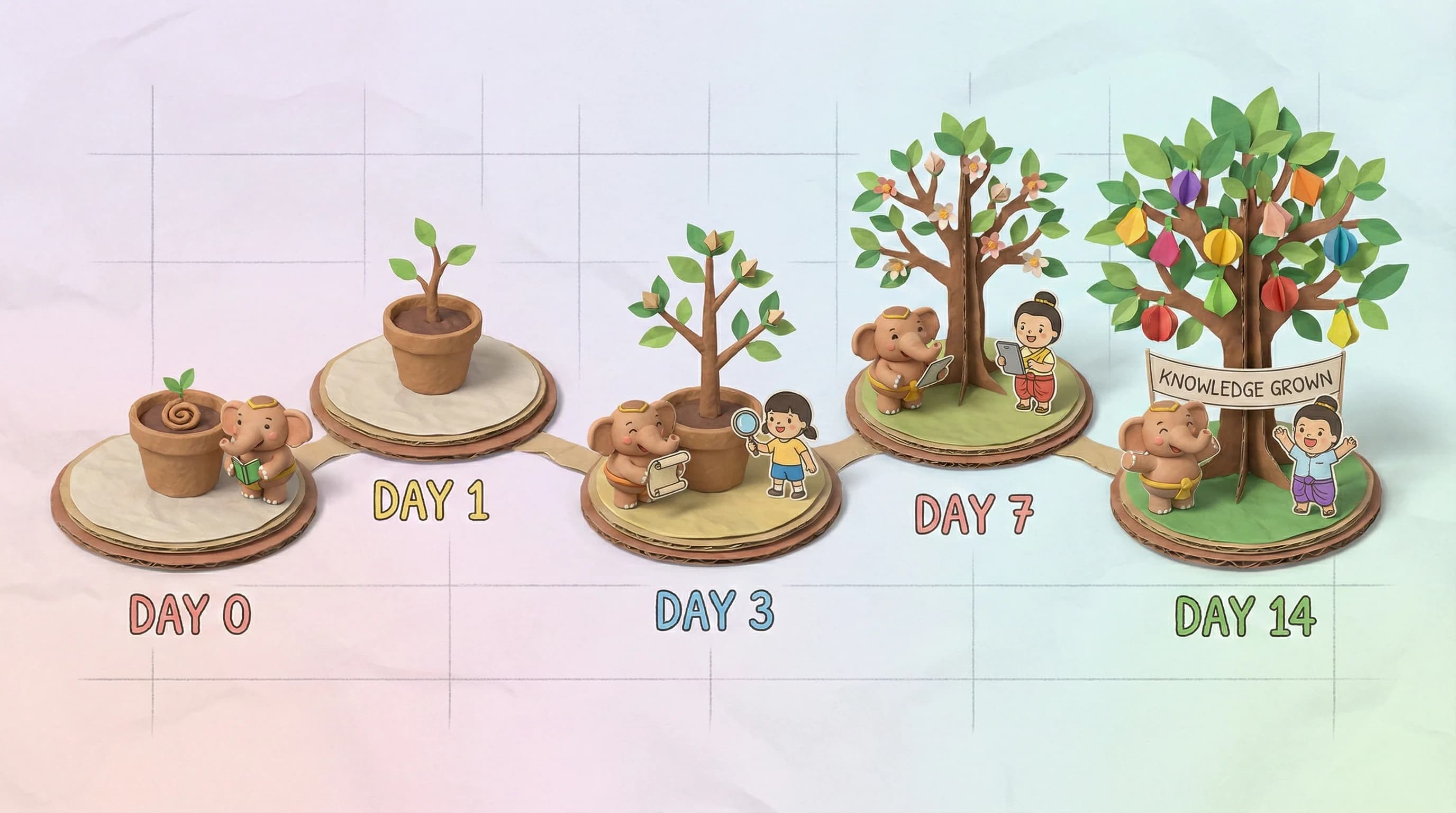 FSRS review timeline showing optimized scheduling
Common Questions About FSRS for Thai Learning
Q: Do I need to be a tech expert to use FSRS?
A: Not at all. Effortless Thai implements FSRS automatically—you just learn words, and the system optimizes itself.
Q: How long until FSRS adapts to me?
A: After about 100-200 reviews, FSRS has enough data to personalize effectively. The system gets smarter the more you use it.
Q: Can FSRS handle Thai script and romanization together?
A: Yes! FSRS treats them as related but separate items, optimizing review schedules for both forms.
Q: What if I have good and bad memory days?
A: FSRS accounts for natural variation. It looks at long-term patterns, not daily fluctuations.
Q: How does FSRS compare to other Thai learning apps?
A: Most apps use basic SRS or fixed schedules. FSRS is 2-3x more efficient according to benchmark studies.
Practical Tips for Maximizing FSRS Benefits
1. Trust the Algorithm
Don't manually reschedule reviews—let FSRS do its job. The algorithm learns from your compliance.
2. Be Honest with Yourself
When reviewing, accurately rate your recall:
- Easy: Instant, confident recall
- Good: Correct after brief thought
- Hard: Recalled with difficulty
- Again: Complete failure
3. Review Consistently
FSRS works best with regular practice. Even 10-15 minutes daily yields better results than occasional long sessions.
4. Let Difficulty Adjust Naturally
Some Thai words will naturally be harder (abstract concepts, similar-sounding words). FSRS will detect this and adjust.
5. Monitor Your Settings
Check your retention rate periodically. If consistently above 95%, consider lowering to 85-90% to learn faster.
The Science Behind FSRS: Peer-Reviewed Results
FSRS isn't marketing hype—it's backed by peer-reviewed research:
- 53% review reduction compared to SM-2 (Anki's old algorithm)
- 89-92% retention rates with optimized parameters
- Personalization accounts for 30% of efficiency gains
- Published in ACM KDD 2022 (top data science conference)
The algorithm continuously improves through community contributions and ongoing research at institutions including Carnegie Mellon and University of California.
Getting Started with FSRS for Thai
Step 1: Initial Setup
- Use Effortless Thai's default FSRS settings
- Learn 10-20 new Thai words daily
- Complete reviews as scheduled
Step 2: First Month
- Don't adjust anything—let FSRS gather data
- Focus on accurate self-assessment
- Notice patterns in which words are difficult
Step 3: Optimization Phase
After 200+ reviews:
- Check your retention statistics
- Adjust desired retention if needed
- Trust the personalized schedule
Step 4: Long-Term Mastery
- FSRS now knows your Thai learning patterns
- Review load decreases as efficiency increases
- More time for new vocabulary acquisition
Conclusion: Smarter Reviews, Faster Progress
FSRS represents a fundamental shift from "one-size-fits-all" scheduling to personalized, optimized learning. For Thai vocabulary—with its tones, script, and cultural nuances—this personalization is particularly valuable.
The result? You spend less time reviewing and more time learning new words while maintaining higher retention rates. Instead of fighting the forgetting curve, you're working with your brain's natural memory patterns.
Traditional method: 30 minutes daily → 300 words/month
FSRS-optimized: 30 minutes daily → 600 words/month
That's the power of modern learning science applied to Thai language acquisition.
Further reading:
- Why Paiboon vs RTGS for Learning Thai Tones
- Common Thai Pronunciation Mistakes & How to Fix Them
- Bangkok Expat Survival Phrases with Audio Examples
Academic references:
- Ye, J. (2022). A Stochastic Shortest Path Algorithm for Optimized Spaced Repetition Scheduling. ACM KDD.
- Ebbinghaus, H. (1885). Memory: A Contribution to Experimental Psychology.
- Wozniak, P. (1990). Optimization of Learning. Master's Thesis.
Related Articles
Days of the Week in Thai (and Each Day's Lucky Color)
Days of the week in Thai start with วัน (wan, 'day'): Monday is วันจันทร์ (wan jan), Sunday วันอาทิตย์ (wan aa-thít). All 7, with tones, audio & lucky colors.
Thai Colors: How to Say Every Color in Thai (with Audio)
Colors in Thai are สี (sǐi) + the word: red is สีแดง (sǐi dɛɛng), blue is สีฟ้า (sǐi fáa). Every color with tones, audio, and light/dark words.