Paiboon vs RTGS: Which Thai Romanization Shows Tones?
Paiboon vs RTGS, compared side by side: RTGS drops all 5 Thai tones and vowel length, Paiboon marks both. See which system to learn before you start reading Thai out loud.
Why Paiboon vs RTGS for Learning Thai Tones: A Visual Guide
If you've ever struggled with Thai tones, you're not alone. The five distinct tones of the Thai language—mid, low, falling, high, and rising—are the #1 obstacle for most learners. The problem often starts with how these tones are represented in romanization systems.
In this comprehensive guide, we'll explore why the Paiboon transliteration system provides a superior learning experience compared to the official Royal Thai General System (RTGS), especially for beginners and intermediate learners.
EffortlessThai colours each syllable by its tone and plays it aloud, so you see and hear the tone together. Two starter decks, no card to sign up. Start here.
The Thai Tone Challenge: Why It Matters
Thai is a tonal language, meaning the same sound with different tones creates completely different words. Consider these examples:
- "khao" with a rising tone means "he/she"
- "khao" with a falling tone means "rice"
- "khao" with a low tone means "news"
Get the tone wrong, and you could be calling someone "rice" instead of referring to them as "he"! This isn't just academic—it's a daily communication challenge for Thai learners.
RTGS: The Official Standard with a Critical Flaw
The Royal Thai General System (RTGS) is Thailand's official romanization system, developed in the 1930s and updated several times since. It's used on street signs, in government documents, and in many educational materials.
RTGS Strengths:
- Consistency: Standardized across official materials
- Official recognition: Used by Thai government and institutions
- Simple representation: Clean, uncluttered text
RTGS Critical Weakness:
No tone indication whatsoever.
RTGS writes "khao" for ข้าว (rice), เขา (he/she), and ข่าว (news)—three different words with three different tones. For learners, this creates confusion and forces reliance on context or memorization without visual cues.
Paiboon System: Visual Tone Learning
The Paiboon transliteration system, developed by Paiboon Publishing for language learners, takes a fundamentally different approach. Created specifically to help foreigners learn Thai, it includes visual tone markers that provide immediate pronunciation guidance.
Key Paiboon Features:
- Tone diacritics: à (low), â (falling), á (high), ǎ (rising), a (mid)
- Consistent vowel representation: Clear distinction between short/long vowels
- Learner-focused design: Prioritizes pronunciation accuracy over official standards
Side-by-Side Comparison
Let's compare how both systems handle common Thai words:
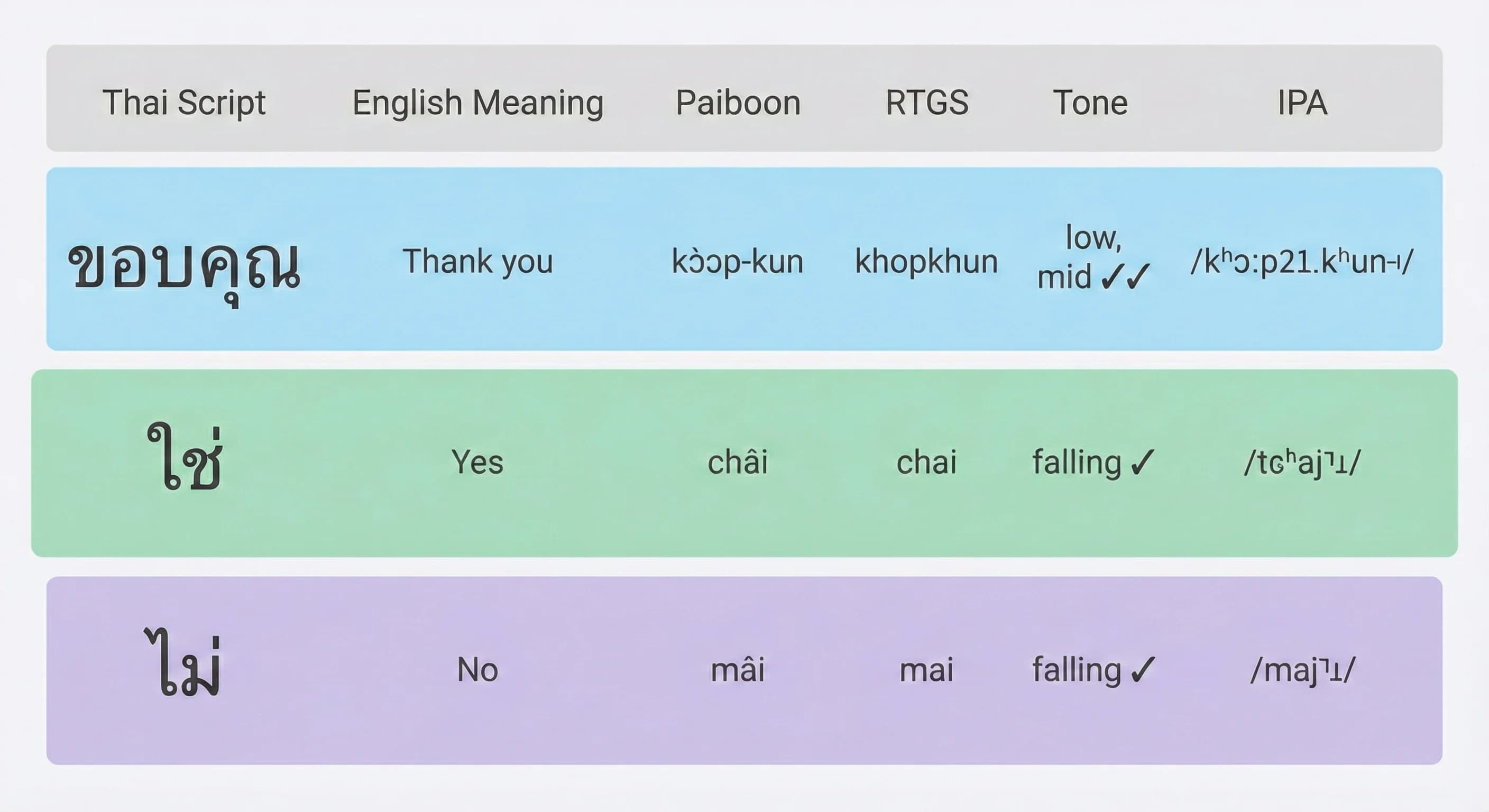 Paiboon vs RTGS comparison table showing tone differences
| Thai Script | RTGS | Paiboon | English Meaning | Tone |
|---|---|---|---|---|
| ข้าว | khao | kâo | rice | Falling |
| เขา | khao | kăo | he/she | Rising |
| เก่า | kao | gào | old | Low |
| ขาว | khao | kăao | white | Rising |
| เค้า | khao | káo | pattern | High |
Visual advantage: With Paiboon, you can see the tone difference immediately. With RTGS, you have to memorize which "khao" is which.
Stop guessing the tones.
Reading about tones is one thing; hearing and seeing them on a flashcard is another. Two starter decks, no card to sign up.
Start learning Thai free →Free to start · 2 starter decks · no card needed
Why Paiboon Works Better for Learners
1. Visual Memory Reinforcement
The human brain processes visual information 60,000 times faster than text. Paiboon's tone markers create visual memory hooks that help cement correct pronunciation. When you see "kâo" with the falling tone marker (â), your brain connects the visual shape with the falling pitch pattern.
2. Reduced Cognitive Load
Instead of memorizing "khao #1 = rice, khao #2 = he/she, khao #3 = white," you learn distinctive patterns:
- kâo (falling) = rice
- kăo (rising) = he/she
- kăao (rising, long vowel) = white
3. Progressive Learning Path
Paiboon supports a natural learning progression:
- Beginner: Rely on Paiboon markers for all words
- Intermediate: Use markers for challenging words only
- Advanced: Transition to Thai script with tone memory established
4. Real-World Application
Many popular Thai learning resources use Paiboon or similar systems:
- "Thai for Beginners" by Benjawan Poomsan Becker (Paiboon Publishing)
- "Speak Like a Thai" series
- Online learning platforms and apps
Addressing Academic Criticism
Some linguists criticize Paiboon for:
- Ignoring stress patterns: Doesn't indicate stressed syllables
- Omitting glottal stops: Doesn't show unwritten glottal stops
- Questionable consonant choices: Uses "g" for ก, "dt" for ต, "bp" for ป
Our perspective: These criticisms are valid for linguistic analysis but less relevant for language learning. For beginners and intermediate learners:
- Tones are priority #1: Tone errors cause communication breakdowns
- Stress comes later: Native speakers understand unstressed syllables
- Progressive refinement: Learn tones first, refine details later
The goal isn't perfect linguistic transcription—it's effective communication. Paiboon gets learners speaking understandably faster.
How Effortless Thai Implements Paiboon Principles
At Effortless Thai, we've built Paiboon's visual approach into our learning system:
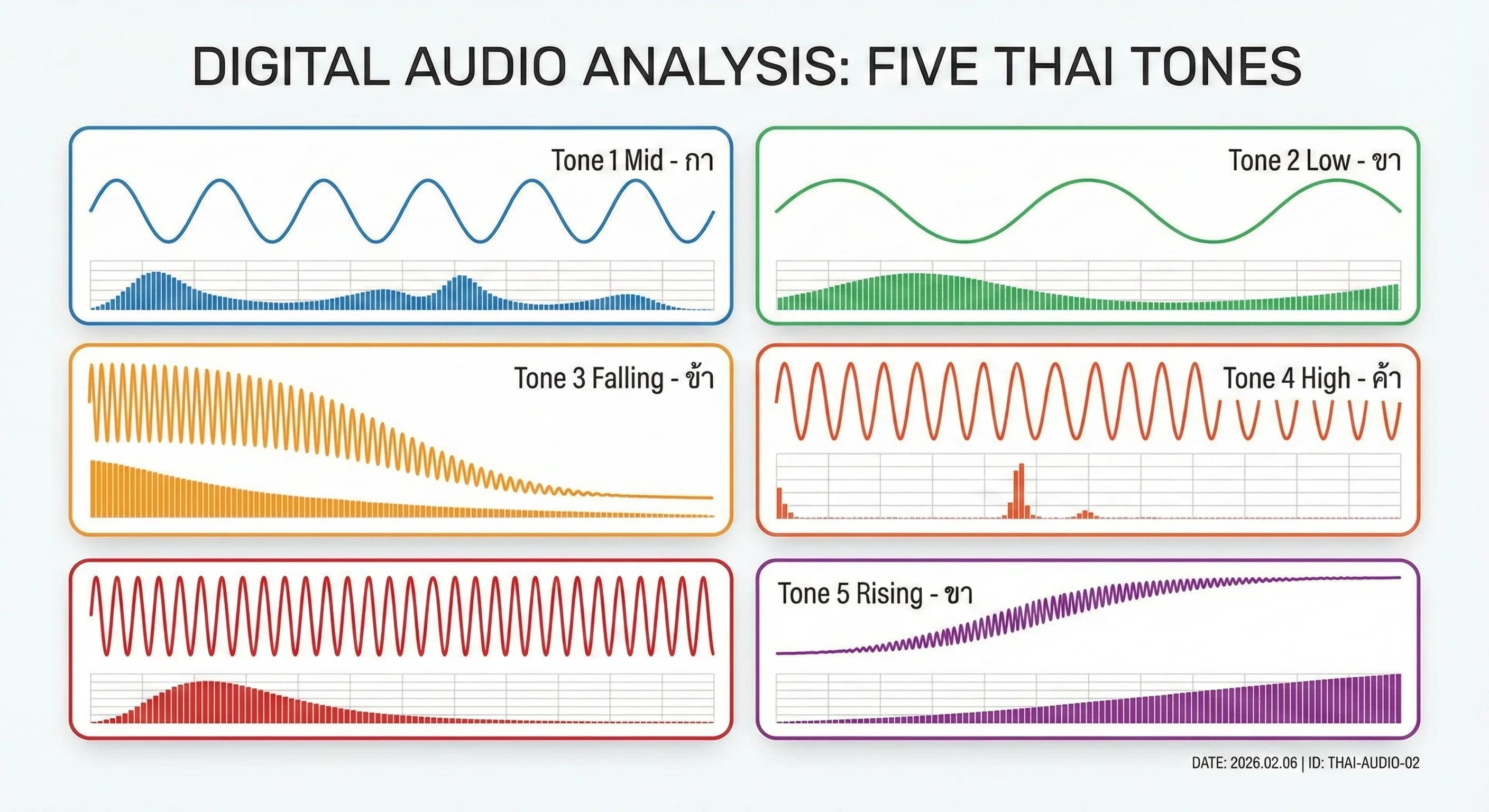 Thai tone waveforms showing five distinct pitch patterns
1. Visual Tone Guides
Every flashcard includes color-coded tone indicators, running coldest to hottest:
- 🔵 Low tone (à) — the coldest, lowest pitch
- 🟢 Falling tone (â) — cooling down, pitch drops
- ⚫ Mid tone (a) — neutral baseline
- 🟠 Rising tone (ǎ) — heating up, pitch rises
- 🔴 High tone (á) — the hottest, peak pitch
Temperature is the whole point: instead of memorising five arbitrary labels, you read pitch as heat. And where we cannot prove a syllable's tone, we say so — those characters render grey with a dotted underline rather than guessing a colour at you.
2. Audio + Visual Reinforcement
Hear the tone while seeing the visual representation, creating multisensory learning that improves retention.
3. Progressive Difficulty
- Level 1: Paiboon + tone colors + audio
- Level 2: Paiboon + audio only
- Level 3: Thai script + tone colors
- Level 4: Thai script only
4. Real Conversation Context
Learn tones from actual Thai conversations you capture, not just isolated words.
Practical Tone Exercises
Try these exercises to improve your tone recognition:
Exercise 1: Minimal Pair Drills
Practice these pairs with our audio examples:
- kâo (rice) vs kăo (he/she)
- mâi (silk) vs mài (not)
- nâa (face) vs nâa (thick)
Exercise 2: Tone Pattern Recognition
Identify the tone patterns in common phrases:
- "sà-wàt-dii" (hello) - low, low, mid
- "khàawp-khun" (thank you) - falling, mid
- "chân rák khun" (I love you) - mid, high, mid
Exercise 3: Recording Comparison
- Record yourself saying target words
- Compare to native speaker audio
- Note which tones need practice
Common Questions About Paiboon
Q: Should I use Paiboon forever?
A: No. Paiboon is a learning tool, not an end goal. Use it to master tones, then transition to Thai script.
Q: What if I see RTGS on street signs?
A: This is common. Use it as practice! Try to determine the correct tone from context, then verify with a Thai speaker or app.
Q: Do Thai people use Paiboon?
A: No, Thais use Thai script. Paiboon is exclusively for learners.
Q: How long should I use Paiboon?
A: Most learners benefit from 3-6 months of Paiboon support while building tone awareness, then gradually reduce reliance.
The Learning Path: From Paiboon to Proficiency
- Months 1-3: Heavy Paiboon use for all vocabulary
- Months 4-6: Paiboon for new/difficult words only
- Months 7-12: Occasional Paiboon reference
- Year 1+: Thai script with confident tone production
Conclusion: Choose the Tool That Works
The RTGS vs Paiboon debate isn't about which system is "correct"—it's about which tool helps you learn effectively. For tone mastery and pronunciation accuracy, Paiboon's visual approach provides clear advantages:
✅ Immediate tone recognition
✅ Reduced confusion between similar words
✅ Faster pronunciation improvement
✅ Smoother transition to Thai script
At Effortless Thai, we believe in using every effective tool available. Paiboon helps you build tone awareness quickly, so you can focus on what matters most: communicating confidently in Thai.
About the author: I'm Richard Ivan. I live in Thailand and I make Effortless Thai on my own — flashcards with audio and colour-coded tones, for the first few hundred words. More about me.
Further reading:
Frequently Asked Questions
What is the difference between Paiboon and RTGS romanization?
Paiboon marks tone and vowel length (for example mài versus máai), so you can pronounce a word correctly from the romanization alone. RTGS — the official Thai system — omits tones and merges several vowel sounds, so it is simpler to read but ambiguous for learners.
Which Thai romanization system is best for learning to speak?
Paiboon. It encodes the five tones and vowel length, the two features that change a Thai word's meaning. RTGS is better suited to place names and street signs, where consistency matters more than exact pronunciation.
Does RTGS show Thai tones?
No. RTGS deliberately leaves out tone marks and vowel-length distinctions, which is why a single RTGS spelling can map to several different Thai words.
Sources & further reading
Related Articles
Why Thai Is a Tonal Language: The 5 Tones (with Audio)
Thai is tonal because pitch changes meaning: เสือ (sʉ̌a) is 'tiger', เสื้อ (sʉ̂a) is 'shirt'. Meet the 5 tones and why they matter, with free audio.
Thai Pronunciation for Beginners: Sounds, Tones & Audio
Thai pronunciation has three parts English lacks: vowel length, unaspirated consonants and five tones. Hear สวัสดี (sà-wàt-dii) and minimal pairs with audio.